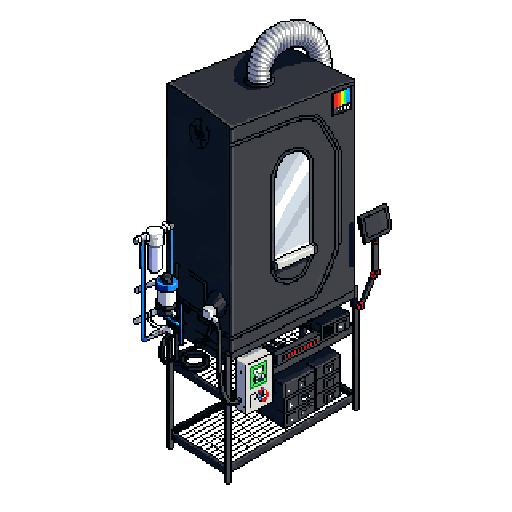
The platform
Phenotyping research, run by AI agents.
Verdant Autonomics is a fleet of identical, networked research pods that run replicated biological experiments under continuous AI control. Each pod is a tightly-controlled growth chamber paired with a dedicated AI technician that monitors the environment, follows the protocol, and records observations. A separate AI lead researcher synthesizes findings across the entire fleet.
We built this platform to ask questions that traditional research can't answer cleanly: factorial trials with proper replication, multi-treatment screening, continuous time-series phenotyping, and bias-free observation at scale.
Today: eight pods operational, first pilot study running, talking to research partners about pod access.
The instrument
One arm. Three problems.
Every pod's defining feature is a single linear-rail-mounted camera arm. The arm carries a camera, a reticle, and an Apogee PAR meter, all under Claude's control. It solves three measurement problems simultaneously — none of which has a clean solution in a fixed-camera growth chamber.
01
Parallax-free height measurement.
The agent slides the camera until the canopy aligns with a red reference line. At alignment, the reticle marks where the line crosses a fixed ruler behind the plant. The agent reads the ruler value — that's the height. No parallax, no math, no per-pod calibration.
02
Canopy-level PAR sensing.
The same arm carries an Apogee PAR meter. Because the arm tracks the canopy throughout the grow, light is measured at the surface that matters — the leaves themselves. The result is a continuous record of light the plant actually received, not light emitted.
03
Automated light distance correction.
Because the pod knows the canopy height, it can adjust the grow light's distance dynamically — holding the canopy at a chosen PAR target throughout the experiment. Scaled across dozens of pods, this eliminates the manual labor of light adjustment entirely.
"One moving arm solves three problems at once."
Martin DeVido · March 2026
Hardware
Inside each pod.
Each pod is a self-contained research instrument. Identical to every other pod in the fleet, calibrated against the reference set, and built to a research-grade specification.
Environmental control
Temperature, humidity, CO₂, light intensity, VPD — programmable per protocol, agent-managed in real time.
Sensing
Atlas Scientific probes — water chemistry, gas concentration, atmospheric composition. Apogee PAR meter on the moving arm.
Fertigation
Internal water + nutrient delivery — automated, programmable, no human intervention required during a study.
Motion
Linear-rail camera arm — Trossen Robotics integration, agent-controlled positioning to sub-millimeter precision.
Lighting
Programmable spectrum & photoperiod — distance-adjustable, PAR-target-driven.
Compute
Onboard agent harness — Claude runs the technician role per pod, with local logging and network sync to the lead researcher.
Identical fleet
Eight pods today, more in production — same hardware, same firmware, same protocol = replicable experiments across the fleet.
The science layer
A static, independent observer for every factorial.
Most experimental science is conducted by researchers who designed the experiment, know the hypothesis, and have an outcome they expect to find. That's a structural bias problem — and in agricultural research, where economic interests routinely shape outcomes, it's particularly acute.
Verdant Autonomics flips the structure. Each pod has a dedicated AI technician that performs observations and protocol management, but knows nothing about the experimental design, the hypothesis, or the other pods. It just does its job: read the sensors, observe the plant, record the data, follow the protocol.
A separate AI lead researcher holds the experimental design and synthesizes across all pods at the end of a study. The lead has the question; the technicians have the data. The wall between them is the structure that makes the observations clean.
Use cases
Experiments that wouldn't run anywhere else.
The pods are well-suited to any experiment where the signal you're hunting is small and environmental noise needs to be tightly controlled.
Additive trials
Fertilizers, biostimulants, microbial inoculants, foliar treatments. The category most punished by environmental variability — and most served by tight control.
Cultivar comparisons
Side-by-side performance of different genotypes under identical, replicable conditions.
Stress response
Drought, heat, cold, nutrient deficiency. Hold any environmental variable while perturbing another.
Protocol optimization
Light recipes, fertigation schedules, photoperiod programs, CO₂ strategies.
Factorial designs
Eight pods give you a 2×2×2 with single replicates, a 3×2 with four reps, or a 2×2 with strong replication. Dimensions grow with the fleet.
Distributed trials
Same protocol, multiple geographic sites, joint analysis. The pods carry their environment with them — climate is no longer a confound.
What's next
From eight pods to a network.
Near-term. Finish the pilot. Validate the hardware. Document failure modes. Publish results.
Medium-term. Onboard the first external research partners. Design v2 pods at a lower unit cost while maintaining calibration against the reference fleet. Run joint factorial experiments with sequencing partners — closing the loop between phenotype and genotype.
Long-term. Distributed pod networks across geographic sites — the same experiment running in Boise, Berkeley, and beyond. Closed-loop life-support systems with internal atmosphere management — oxygen scrubbers, full data acquisition for sealed-environment research. Continuous experimental capacity that no single lab can match.